-min.jpg)

Treating every past-due account the same wastes resources on calls that would never convert and misses debtors who only needed a simple reminder. A propensity-to-pay score fixes that by predicting who is likely to pay before a team decides how, when, or whether to make contact, turning propensity to pay into the starting point for a smarter collection strategy.
What Is a Propensity-to-Pay Score?
A propensity-to-pay score estimates the probability that a specific debtor will make a payment within a defined window. It is a prediction, not a certainty, built from historical data about how similar accounts have behaved in the past.
Collection teams use the score to decide which accounts to prioritize, which channel to use, and how much effort a given account justifies. Left unscored, a portfolio gets treated as if every debtor carries the same likelihood of paying, which quietly inflates bad debt and drains collection budgets on accounts that were never going to convert.
How Does a Propensity-to-Pay Model Work?
A propensity-to-pay model pulls together several layers of data to generate that probability, and each layer adds a different signal about a debtor's behavior. Accounts that go unscored and unmanaged for too long often drift toward charge-off, at which point recovery becomes far more expensive.
Historical Data and Payment History
The strongest predictor of future payment is past payment behavior. Historical data on payment history, including whether a debtor paid late but consistently or never responded at all, carries more weight in the model than any single recent event.
Credit History and Third-Party Data
Credit history adds an external view of financial capacity: existing debt load, credit scores, and reported delinquencies on other accounts. Third-party data sources, such as bureau records or verified income signals, help distinguish a debtor who cannot pay from one who simply has not been reached yet.
Predictive Analytics and Machine Learning
Predictive analytics and machine learning combine these inputs into a single score, then update it as new events occur: a payment, a missed promise, a new contact attempt. This is where artificial intelligence changes the economics of collections, since a model can re-score an entire portfolio overnight instead of once a quarter.
How Is Propensity to Pay Different From Ability to Pay and a Credit Score?
Propensity to pay and ability to pay sound similar but measure different things, and conflating them leads to bad prioritization decisions. Ability to pay asks whether a debtor has the financial capacity to pay this debt; propensity to pay asks whether that debtor will actually choose to pay it now.
A high credit score does not guarantee a high propensity-to-pay score: a financially healthy debtor can still be unresponsive or in dispute. Reading all three signals together, instead of any single one, is what keeps a collection strategy from misreading who is actually ready to pay.
How Do Collection Teams Use Propensity-to-Pay Scores in a Collection Strategy?
Once a score exists, it drives three practical decisions: which accounts to work first, which channel to use, and how much to offer in a payment plan. This turns propensity to pay from an analytics exercise into a day-to-day operating rule for the collection team.
Segmentation by Payment Likelihood
Segmentation splits the portfolio into tiers, typically high, medium, and low propensity, which is the core of modern delinquency management. The same resources should not be spent evenly across accounts with very different odds of paying. High-propensity accounts often need only a low-cost reminder, while low-propensity accounts call for a different approach entirely.
Personalized Payment Plans
A score also shapes the payment plan itself. A debtor with high propensity and a temporary cash flow problem may only need a short extension, while a debtor with low propensity and a large balance may need a longer, smaller-installment plan to make paying feel achievable at all.
Channel and Outbound Call Prioritization
Outbound calls are the most expensive channel per contact, so they should go to the accounts where a human conversation actually changes the outcome, not to every past-due account by default. Digital channels, like SMS and email, absorb the high-propensity volume so agents can focus on the accounts that need judgment.
Should Collection Teams Build or Outsource Propensity-to-Pay Solutions?
Building an in-house propensity-to-pay model from scratch requires historical data at scale, a data science team, and months of tuning before the score is reliable enough to act on. That data science layer is different from what most debt collection software provides out of the box, which is why propensity to pay solutions are increasingly bought rather than built.
Outsourcing the model to an existing collections infrastructure lets a team skip that buildout and start prioritizing accounts in weeks instead of quarters. The trade-off is choosing a partner whose model was trained specifically on collections behavior, across the channels and account types a creditor actually manages.
Why Is Propensity to Pay Central to Colektia's Infrastructure?
Colektia is built around this kind of outsourced scoring: a predictive model that scores every account for propensity to pay and updates it continuously, then uses that score to set the channel, tone, and timing of each contact.
For a banking client, this approach lifted early-delinquency containment to 78% versus 75% for a traditional human-agent process, at 3.6 times lower cost to manage, across a sample of 12,000 accounts. At Colektia, this technology has been shown to match the effectiveness of a traditional call center and subsequently surpass it by 25%, while operating with 100% automation.
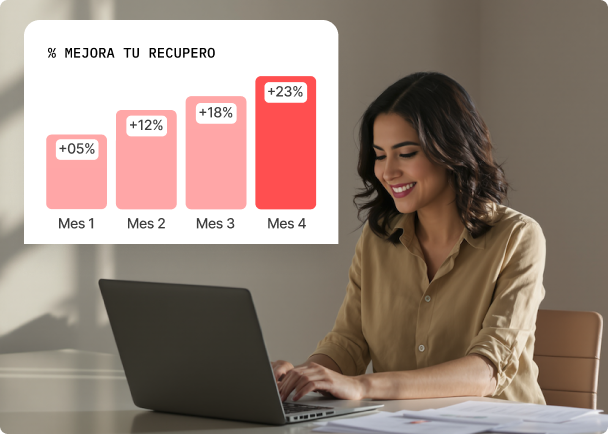
- Recovery: up to 25% higher recovery in early delinquency
- Cost: up to 30% lower cost to manage the same portfolio
- Speed: implementation in under 3 weeks, measurable results in under 8
Propensity to pay turns an undifferentiated portfolio into a set of accounts ranked by real probability, so collection strategy, channel choice, and payment plans are built on evidence instead of guesswork. That shift alone often does more for collection rate and cash flow than adding headcount.
Schedule a meeting with our collections experts to see how a live propensity-to-pay score would reorder your current portfolio.
Frequently Asked Questions
What is a propensity-to-pay score?
A propensity-to-pay score is a number that estimates how likely a specific debtor is to make a payment within a given period, based on historical data such as payment history, contact response, and account age. Collection teams use it to prioritize which accounts to work first and which channel to use, rather than treating every past-due account the same way regardless of how likely that debtor actually is to pay.
How is propensity to pay different from a credit score?
A credit score measures general creditworthiness across all of a person's obligations, usually to support a new lending decision. A propensity-to-pay score is narrower and more current: it measures how likely one specific debtor is to pay one specific past-due balance right now, using recent payment history and behavior rather than a broad, static credit profile. That's why a debtor with a strong credit score can show a low propensity-to-pay score if unresponsive on this account.
How much historical data is needed to build a propensity-to-pay model?
Most propensity-to-pay models need a meaningful volume of historical accounts, generally in the thousands, with recorded outcomes: who paid, under what contact strategy, and how long it took. Smaller data sets can still support a first version of the model, but accuracy improves as more historical data and payment patterns accumulate, especially data that includes both successful and failed collection attempts.
Can a collection team use propensity to pay without an in-house data science team?
Yes. Outsourcing to a collections infrastructure that already includes a propensity-to-pay engine removes the need to hire a data science team internally. This is one of the main reasons propensity to pay solutions are typically bought rather than built from scratch, since the scoring model, the data pipeline, and the ongoing tuning all come as part of the service, not as a separate project.
Does propensity to pay replace outbound calls?
No. Propensity to pay decides which accounts deserve a call, not whether calls disappear entirely. High-propensity accounts are usually resolved through low-cost digital channels, which frees outbound calls, the most expensive channel per contact, for the accounts where a human conversation genuinely changes the collection rate, such as disputes or larger negotiated payment plans. It also helps managers plan headcount around actual need.
Does propensity to pay work the same way across industries?
The mechanics are the same across banking, fintech, telecom, utilities, retail, and insurance: historical data and payment patterns train a model that scores likelihood to pay. What changes by industry is which signals matter most and how quickly delinquency compounds, so a model trained on one creditor's data does not automatically transfer cleanly to another sector's portfolio without retraining on that creditor's own historical accounts.